Budget Reality Calculator
Every line a first quote leaves out: approvals, site development, professional fees, contingency, GST, the connections, the compound wall. It returns a total, a stage-wise cash flow, and a funding gap if there is one.
A decision system made by two architects, that gives you the right tools when you need them.

Longer, probably, than the rest of your family knows.
You know the family that ended up ₹40L over budget. You know the plot with the title problem that came to light after the token amount was paid. You know the friend whose living room turns into a furnace in April because the drawings were signed off before anyone thought about which way the windows faced.
Some are relatives. Some are friends. Every one of those stories is different, and the shape of them is always the same.
Some of these stories are about you, at month six of a project that was supposed to be simpler than this.
"We're careful people. We'll read up."
"Our contractor came recommended."
"The architect will handle it."
None of the people in those stories were ignorant. They all started exactly where you are.
Any of this sound familiar?
And then the mistakes start to pile up.
Because even with a good architect, you still have to decide
There's a moment in most builds, usually around month four, when you realise you've been approving things you didn't fully understand.
The concrete is poured.
The walls are built.
The cost of a half-understood decision has just become permanent.
Each person on your team is responsible for one part, and most of them, in our experience, do that part competently and in good faith.
But explaining the whole system to you was never part of anyone's fee.
It couldn't be. If your architect stopped every meeting to teach you construction management, they'd be losing money on your project.
But you already know all this,
because you have watched it happen.
Time and time again.
Now is your chance to do something about it.
Sounds like a lot? You will be reading at your own pace over the span of 18 to 36 months, only what is relevant to your build.
The costs come as ranges rather than clean single figures. You cannot plan a year of your finances around a number until you know the top of it.
51 sections, so you can hold that conversation as an informed participant.
Roughly 470 priced lines at 2026 Karnataka rates, so a quote can be checked instead of trusted.
607 field notes on the small decisions that are cheap now and expensive later.
Six problems come up in almost every build. Open one.
The tools that make it possible.
Every line a first quote leaves out: approvals, site development, professional fees, contingency, GST, the connections, the compound wall. It returns a total, a stage-wise cash flow, and a funding gap if there is one.
Set which way your plot faces and see where the heat lands through the day. What comes out is a list of specific questions for your architect, before the drawings are issued.
What to check at each stage, on your phone, while you are standing on the site. Every visit logged with dates and photographs, so you have a record rather than a memory.
Up to 3 contractors compared line by line across 45 priced items and 9 commercial terms. It flags what one of them left out and the others priced, and where a rate is far off the rest.
Your loan disbursement against your contractor's payment schedule, month by month. The two are offset by design, and the gap between them comes out of your own pocket. This shows how wide it gets, and when.
Your whole build on one chart, from today to the year after you move in. Order deadlines calculated backwards from your dates, and a flag where the slab lands inside the monsoon window.
What usually happens: you get flooded with information at the beginning of your project and don't know where to start. We track your phase and tell you what matters most.
You tell us where you are when you set up your project, and you get the handful of things worth doing at that stage.
Everything you need during your build process, neatly organized in your own library.
Nothing is locked. Every module and tool is open from the day you join. The guidance decides what to put in front of you, never what to keep from you.
Try it. Ask what to look for when choosing windows.
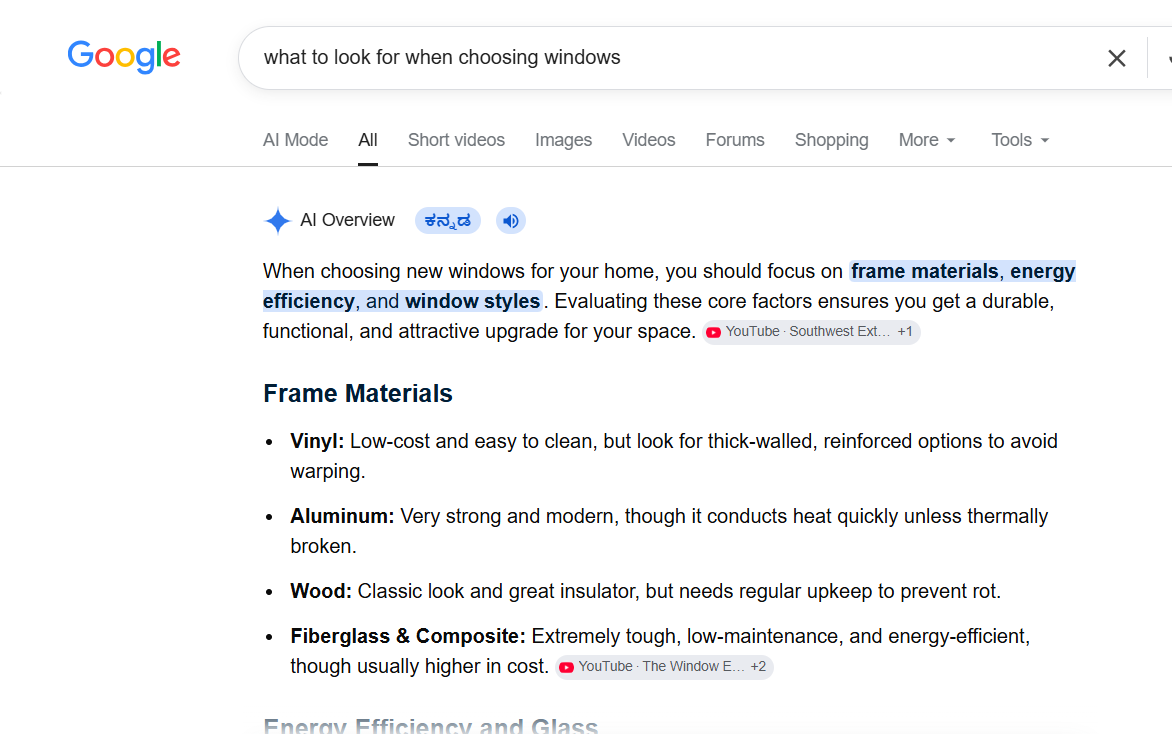
Nobody searches for a drip groove. You can only ask about the things you know exist.
It arrives in the same confident voice whether it is right for a house in Mysore or right for a house in Minnesota. It does not know your plot, your bylaws, this year's rates in your city, or the openings your contractor has already cast. It will answer whatever you put to it, including the question you should not have been asking.
The parts that are wrong look exactly like the parts that are right. Telling them apart needs you to already know the answer, which is the thing you went looking for.
We use these tools ourselves, most days. They are quick, and they are useful once you know enough to judge what comes back. Knowing enough to judge it is what this is for.
When your question goes past what we have written, it tells you so before it answers. We would rather you knew which of the two you were reading.
It is an assistant, not a professional. Anything you plan to act on, has to get approved by your architect, engineer or lawyer first.
Vanessa trained in architecture and urban planning in Poland, and won a national award for the design of an urban district. Lakshman trained in architectural technology and construction management in Denmark and came back to India in 2017. We met in 2016 on the sustainability team of a festival, and have been partners in work and in life since.
For six years we ran a café and a small hostel in Bangalore. Both taught us more about how buildings actually get used, and how they fail, than a studio would have. We closed them in early 2025, and now practise from Mysore, with two children.
Here is the part that matters more than any of that.
Most of what gets built in this country is not designed by an architect. It goes up from memory, from what the neighbour did, or from a plan drawn by the contractor. No concept, no brief, often copied one to one from a template. It is the reason so many houses are hot when they could have been cool, dark when they could have been bright and airy, and cost a third more than they needed to.
A client who knows what they are looking at gets better work out of everyone they hire: the architect, the structural engineer, the contractor, and every tradesperson after them. They know what good work looks like, what it should cost, and what to ask for.
We'll say one more thing directly. We are not India's most senior residential architects, and there are practices with far more houses behind them than ours. What we have is a decade of watching the same handful of mistakes recur, project after project, and the reference we wished we could hand someone like you on day one.
And that is why we created
Build Informed.
A few things we decided at the start:
Not cement, not tile, not fixtures, not fittings. The day we recommend a brand, you can't trust the advice.
We are paid by you and by nobody else on your project.
So you can read what you're paying for before you pay for it.
We can't promise you a build with no surprises. If someone can, be careful.
But if "worth it" means:
Then yes. That's what this holds up.
On an ₹85L build, ₹35,000 is 0.4% of what you are about to spend.
Even the small mistakes run ₹50,000 to ₹1 lakh, and there is no ceiling on the big ones.
Catch one before it happens and Build Informed has paid for itself.
₹35,000
₹79,000
Everything in Self-serve, plus:
Take Self-serve. It is the whole system, and most people building one house do not need more than that.
Take Guided if you are running the build from abroad, if you and your partner are not yet agreed on the budget, or if you have never read a contractor's quote before and would rather someone who has read a few hundred of them tell you what yours says.
25 places a year. When they are taken, Guided closes until January.
Module 1 is free.
After you buy you can open one more paid module and still ask for a full refund within 15 days.
One payment. Lifetime access for your own projects. No subscription.
Pay by UPI, card or netbanking.
Move from Self-serve to Guided later for ₹44,000, if places remain that year.
Testimonial 1
Testimonial 2
Testimonial 3
The whole module, not a sample. Whether you're ready to build at all, with the readiness scorecard and the budget calculator alongside it.
If it's useful, the rest will be. If it isn't, you've lost an evening and learnt something about your own readiness either way.
No. It's a decision-safety system: checklists, tools, and guidance that surfaces each decision as your build reaches it.
No. Those come from your architect. This makes you the client who briefs them well and catches what's missing before it's built.
It doesn't replace them. It helps you understand what they're showing you and decide faster, which makes their job easier and their work better.
The decisions ahead of you are still open. Set your phase and put your attention on what you can still get right.
Everything is written and asynchronous. You read at your midnight and brief your family in the morning, theirs. There's a module for running the project from outside India.
No. There are no brand recommendations in the material, for exactly that reason.
Module 1 is free, so you can judge the depth, tone, and approach before paying anything. After you purchase, you may open one further paid module and take your time with it. If Build Informed isn't right for your project, tell us within 15 days of purchase and we'll refund you in full. Eligibility ends at whichever comes first: 15 days from purchase, or the moment you open a second paid module. We do it this way because one complete paid module, on top of the free one, is enough to know whether this works for you.
Free, three tools included, and it will tell you something useful about your own build before you spend anything.